What to Do When Someone Is Drowning: A Step-by-Step First Aid and CPR Guide
Willow Grove CPR • July 3, 2026
What to Do When Someone Is Drowning: A Step-by-Step First Aid and CPR Guide
Learn how to recognize a drowning emergency, provide immediate care, and perform CPR safely until EMS arrives.
Why Drowning Emergencies Require a Different Response
Every second matters during a drowning emergency.
Unlike sudden cardiac arrest, drowning is typically caused by a lack of oxygen. When a person is submerged underwater, their airway becomes compromised, preventing oxygen from reaching vital organs such as the brain and heart.
According to water safety experts, prompt recognition and intervention significantly improve survival rates and reduce the risk of permanent neurological damage.
Understanding how to respond correctly before emergency responders arrive can save a life.
What Is Drowning?
Drowning is a process that occurs when breathing is impaired due to submersion or immersion in water.
Contrary to popular belief, drowning victims are often unable to call for help because their body's primary focus is trying to breathe.
Drowning can occur in:
Swimming pools
Lakes
Rivers
Oceans
Bathtubs
Water parks
Even a few inches of water
In fact, infants and small children can drown in surprisingly small amounts of water, making constant supervision critical.
How to Recognize a Drowning Emergency
Many people expect drowning to look dramatic.
In reality, drowning is often silent.
Common Signs of Active Distress include:
Head tilted back
Mouth at water level
Gasping for air
Vertical body position
Weak or ineffective swimming movements
Inability to call out
Signs the Person Has Been Rescued but Needs Immediate Care
Unresponsive
Not breathing normally
Blue or gray skin color
Weak pulse
Confusion or altered mental status
Step 1: Make Sure the Scene Is Safe
Before attempting a rescue, evaluate the environment. Ask yourself:
Are there strong currents?
Is the water deep?
Are there hazards nearby?
Can I reach the victim without entering the water?
Remember: A rescuer who becomes a victim cannot help anyone.
Step 2: Call for Help Immediately
As soon as a drowning emergency is identified:
Shout for help
Call 911
Send someone to retrieve an AED if available
Early activation of EMS is one of the most important actions you can take.
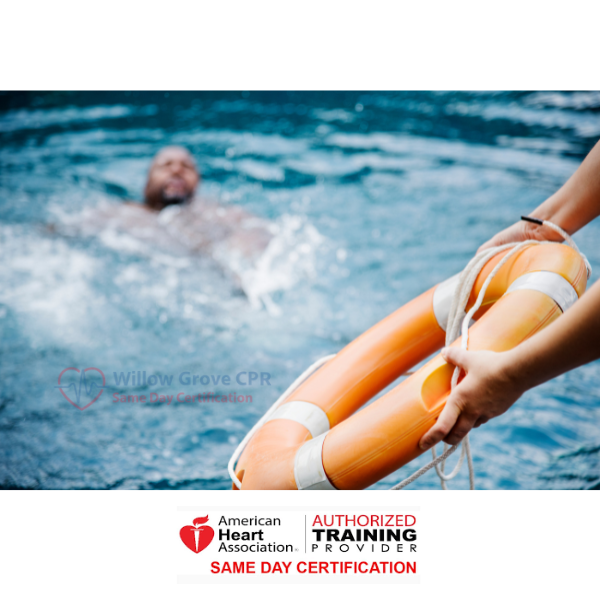
Step 3: Reach or Throw—Don't Go
Whenever possible, avoid entering the water.
Use:
A rope
Rescue tube
Shepherd's hook
Pole
Flotation device
Encourage the victim to grab the object and pull them to safety.
This principle is commonly taught in water rescue and First Aid CPR courses because it protects both the victim and rescuer.
Step 4: Remove the Person From the Water
If it can be done safely:
Move the victim to shallow water or land
Keep their face above water
Minimize unnecessary movement
Be especially cautious if:
They dove into shallow water
They struck rocks or underwater objects
A head, neck, or spinal injury is suspected
Step 5: Check Responsiveness and Breathing
Once out of the water:
Tap and shout.
Check for normal breathing.
Observe chest movement.
If the person is responsive and breathing:
Monitor them closely
Wait for EMS
Keep them warm
If the person is unresponsive and not breathing normally: Immediate intervention is required.
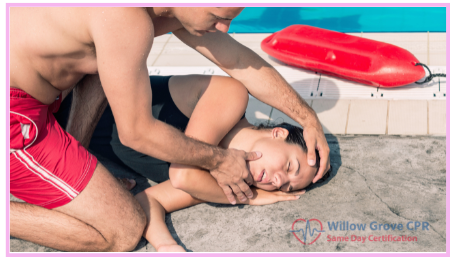
Step 6: Open the Airway and Give Two Rescue Breaths
Because drowning is primarily an oxygen-related emergency, rescue breaths are particularly important.
Open the airway using:Head Tilt–Chin Lift
Place one hand on the forehead and gently lift the chin.
If spinal injury is suspected, follow current emergency response protocols and minimize neck movement.
Give: Two Effective Rescue Breaths
Each breath should:
Last approximately one second
Cause visible chest rise
If you cannot provide mouth-to-mouth ventilation: Use mouth-to-nose breaths instead.
Step 7: Don't Waste Time Trying to Remove Water
One of the biggest myths about drowning emergencies is that water must be drained from the lungs before CPR begins.
This is not recommended.
Do not:
Hang the victim upside down
Attempt to drain water
Delay ventilation
Instead: Focus on providing oxygen through rescue breathing and CPR.
Step 8: Begin CPR If Needed
After providing the initial rescue breaths, reassess the person. If they remain unresponsive and are not breathing normally, begin CPR immediately. For an adult, provide cycles of 30 chest compressions followed by 2 breaths, with compressions delivered at a rate of 100 to 120 per minute.
Breaths are especially important in drowning emergencies because drowning typically begins with oxygen deprivation. High-quality chest compressions help circulate blood, while effective rescue breaths help deliver oxygen to the lungs. If another trained rescuer is available, work together to minimize interruptions and maintain effective CPR.
Step 9: Use an AED as Soon as It Becomes Available
Yes, an AED can be used on a drowning victim. First, make sure the person is completely out of the water. Quickly wipe the chest dry so the AED pads can adhere properly, turn on the AED, and follow its prompts.
If a shock is advised, make sure no one is touching the person before delivering it, then immediately resume CPR. If the AED says “no shock advised,” continue CPR as instructed. The AED does not replace CPR—the two work together to provide the person with the best possible chance of survival.
Step 10: Continue CPR, Breaths, and AED Use Until Help Takes Over
Once CPR has started, continue providing compressions and breaths while following the AED's instructions. Avoid unnecessary interruptions to chest compressions and continue care until the person begins breathing or responding, trained emergency responders take over, or another appropriate reason requires you to stop.
If the person begins breathing normally, continue monitoring them until EMS arrives. Even someone who appears to recover after a drowning emergency should receive appropriate medical evaluation.
Drowning Prevention Is Just as Important as Knowing CPR
The best drowning emergency is one that never happens. Water safety relies on multiple layers of protection, including close supervision, swimming lessons, appropriate pool barriers, and properly fitted U.S. Coast Guard-approved life jackets when appropriate. Young children and beginning swimmers require especially close attention around water.
Drowning can happen quickly and in less water than many people realize. Pools, lakes, rivers, bathtubs, and other bodies of water can all present risks. Another simple rule is worth remembering: never swim alone.
Why Learning Drowning CPR in Person Matters
Reading the steps is useful, but performing them during a real emergency is different. Hands-on CPR training gives you the opportunity to practice rescue breathing, chest compressions, airway positioning, AED operation, and working with another rescuer before someone's life depends on your ability to do them.
Training also teaches skills that are difficult to learn from an article—such as recognizing effective chest rise, performing high-quality compressions, and moving confidently from one step of an emergency response to the next.
Learn CPR, AED, and First Aid Skills at Willow Grove CPR
At Willow Grove CPR, students develop practical emergency-response skills through hands-on training. As an American Heart Association Training Site serving Willow Grove, Montgomery County, Philadelphia, and surrounding communities, we provide training for college students, healthcare professionals, and community members.
Whether you need a First Aid CPR Course, AHA BLS Certification, or BLS Provider Certification, the goal is bigger than earning a certification card. It's learning how to recognize an emergency and having the skills to respond when someone needs help.
The Most Important Thing to Remember About a Drowning Emergency
Drowning is fundamentally a breathing emergency. Once the person has been safely removed from the water, call 911, provide appropriate rescue breaths, begin CPR when indicated, and use an AED as soon as it becomes available. Do not delay CPR by attempting to drain water from the person's lungs.
Knowing the steps is important, but practicing them builds the skills needed to perform under pressure. That's why hands-on CPR, AED, First Aid, and BLS training in the Philadelphia area can be so valuable: when a real emergency happens, you need to be ready to act.
Learn Drowning Response Skills at Willow Grove CPR
At Willow Grove CPR, students receive hands-on training through nationally recognized American Heart Association programs designed to prepare responders for real emergencies.
Whether you're looking for a:
Experienced instructors at Willow Grove CPR teach practical skills that can help save lives both in and out of the water.
Explore key strategies for improving cardiac arrest survival rates, including high-quality CPR, rapid response, immediate defibrillation, and comprehensive post-care. Discover how a strong system of care guided by the American Heart Association's ACLS Provider Systems of Care can make a life-saving difference. Willow Grove CPR is dedicated to Improving Cardiac Arrest Survival. In this article we provide Essential Strategies and Care Systems